 EN
EN

Introduction
The commercial real estate industry is undergoing a profound transformation driven by changing consumer demands, with indoor entertainment venues emerging as key anchors to boost foot traffic and asset value. According to the 2024 Global Commercial Real Estate Entertainment Sector Report by Statista, indoor playgrounds have become the second-fastest growing indoor entertainment category in commercial complexes, with a year-on-year growth rate of 12.3% in investment volume. However, many commercial real estate investors face dilemmas such as unclear profit models, mismatched space utilization, and uncertain payback periods when entering this sector. This article will focus on the investment value of indoor playgrounds, analyze core profit drivers and space adaptation strategies based on authoritative data and practical cases, and provide actionable investment guidance for commercial real estate investors.
Market Drivers of Indoor Playground Investment in Commercial Real Estate
The surge in investment demand for indoor playgrounds in commercial real estate is supported by multiple market drivers. Firstly, the family consumption upgrade has significantly increased demand for parent-child entertainment. Data from the Ministry of Culture and Tourism of China 2024 shows that family parent-child consumption accounts for 38% of total commercial consumption, and indoor playgrounds, as a core parent-child entertainment scenario, have a customer retention rate 2.5 times higher than other entertainment formats. Secondly, commercial real estate's demand for traffic synergy promotes the layout of indoor playgrounds. A research report by CBRE (2024) points out that commercial complexes with indoor playgrounds have an average foot traffic increase of 18%, and the average stay time of customers extends from 90 minutes to 150 minutes, directly driving the sales of surrounding catering, retail and other formats. Thirdly, the maturement of the indoor playground industry reduces investment risks. The global indoor playground equipment supply chain completion rate has reached 92% (Made-in-China.com 2024 data), and the cost of equipment procurement and operation has decreased by 15% compared with five years ago, further improving investment profitability.
Another key driver is the policy support for family-friendly commercial facilities. Many cities in China, Europe and North America have introduced policies to encourage commercial real estate to add parent-child entertainment facilities, including tax incentives and floor area ratio preferences. For example, the European Union's "Family-Friendly Commercial Space Guidelines" (2023) stipulates that commercial complexes with indoor playgrounds that meet safety standards can enjoy a 5% reduction in corporate tax, which directly lowers the investment cost threshold for investors.
Core Profit Indicators and ROI Calculation Model of Indoor Playgrounds
For commercial real estate investors, mastering core profit indicators and establishing a scientific ROI calculation model is crucial to determining investment feasibility. The core profit indicators of indoor playgrounds mainly include per unit area efficiency, customer repeat purchase rate, secondary consumption conversion rate and equipment utilization rate. According to the 2024 Indoor Entertainment Industry Operation Benchmark Report released by China Amusement Machinery and Equipment Association, the average per unit area efficiency of high-quality indoor playgrounds in first-tier cities is 3,800 yuan/㎡/month, the customer repeat purchase rate is 42%, and the secondary consumption conversion rate (including food and beverage, derivative products, etc.) reaches 35%.
The ROI calculation model should cover initial investment and long-term operating costs. The initial investment mainly includes equipment procurement costs (accounting for 55-60% of the total investment), site renovation costs (20-25%), and pre-opening promotion costs (5-8%). Taking a 500 ㎡ indoor playground in a medium-sized city as an example, the initial investment is approximately 1.8-2.2 million yuan. Long-term operating costs include rent (15-20% of monthly revenue), staff salaries (12-15%), equipment maintenance costs (3-5%) and utility fees (2-3%). Based on the above data, the monthly break-even revenue of the playground is about 120,000 yuan. If the average daily number of customers is 150 and the average per customer consumption is 30 yuan, the monthly revenue can reach 135,000 yuan, and the break-even can be achieved in about 16-18 months. The average ROI of mature projects is 18-22% (Euler Hermes 2024 Industry Investment Risk Report).
It should be noted that the ROI of indoor playgrounds is affected by factors such as location, customer group positioning and operation management. For example, playgrounds located in core business districts have 30% higher per customer consumption than those in suburban areas, but the rent cost is also 25-30% higher. Therefore, investors need to adjust the calculation model according to specific project conditions.
Space Adaptation Strategies for Indoor Playgrounds in Commercial Real Estate
Scientific space adaptation is the key to maximizing the investment value of indoor playgrounds. Firstly, in terms of site selection, it should match the customer group positioning of the commercial complex. For family-oriented commercial complexes, the playground should be located on the 3rd-5th floor (with convenient elevator access), away from noisy areas such as cinemas and catering, to ensure a safe and comfortable environment for children. For urban commercial complexes targeting young and middle-aged people, small-scale themed indoor playgrounds can be arranged on the 1st-2nd floor to attract parent-child customers passing by.
Secondly, the space layout should follow the principles of "traffic flow optimization + functional zoning + safety redundancy". The traffic flow design should avoid cross-flow of people, and set up clear entrance and exit channels and rest areas. Functional zoning should include children's activity area (accounting for 60-65% of the total area), parent rest area (15-20%), secondary consumption area (10-15%) and service area (5-8%). According to the GB 50352-2019 "Unified Standard for Building Design of Civil Buildings", the per capita activity area of indoor playgrounds should not be less than 2.5 ㎡, and the width of main passages should not be less than 1.8 meters to ensure the safety of crowd evacuation.
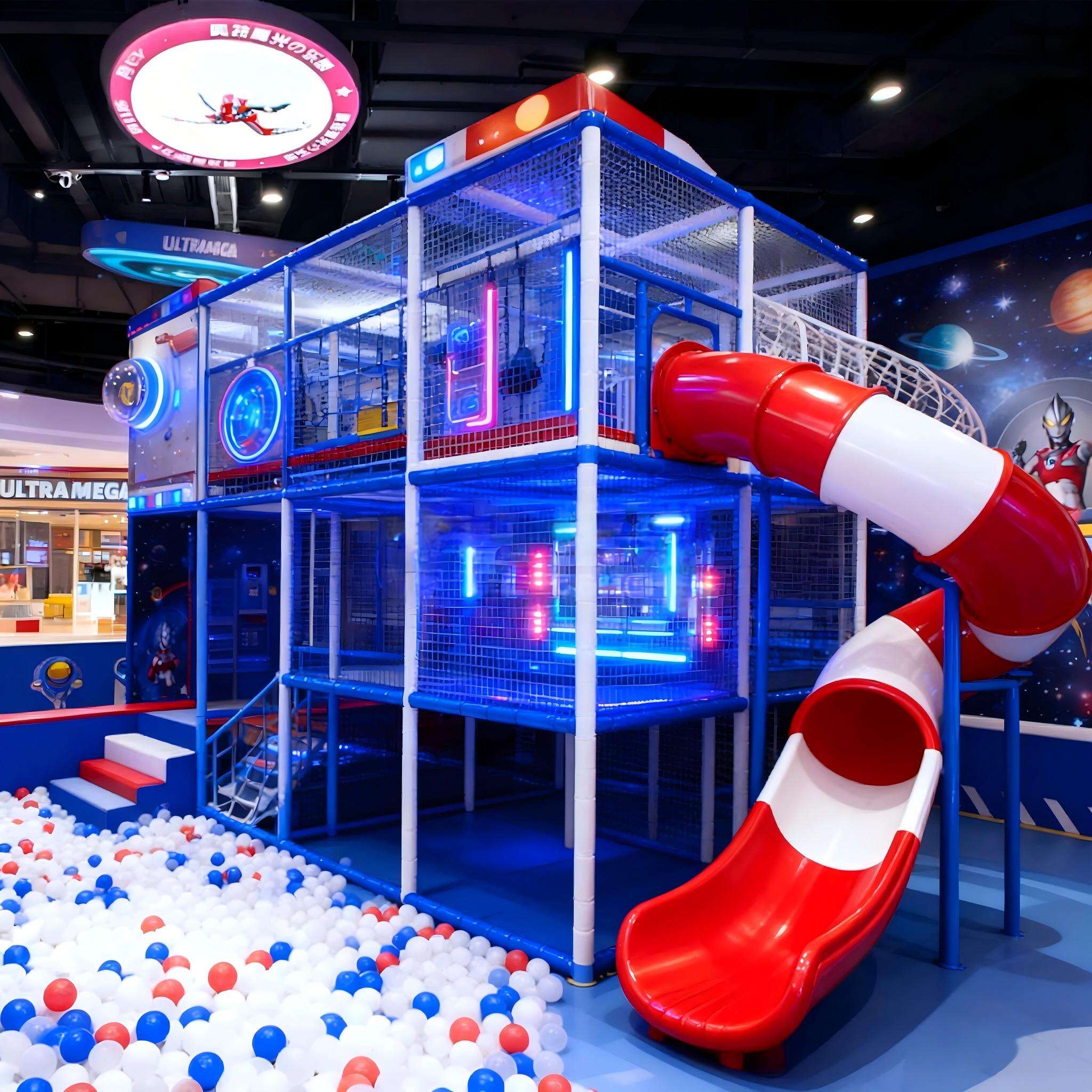
Thirdly, the space theme and decoration should be consistent with the overall positioning of the commercial complex. For example, a commercial complex with a "marine theme" can design the indoor playground into an "underwater world" style, with matching equipment such as slides shaped like dolphins and climbing frames shaped like coral reefs. This not only enhances the immersive experience of customers but also achieves synergy with the overall brand image of the commercial complex. According to a case study by IKEA Centres, commercial complexes with themed indoor playgrounds have a 23% higher customer satisfaction rate than those with ordinary playgrounds.
Risk Control and Sustainable Operation Strategies for Indoor Playground Investments
Commercial real estate investors need to establish a comprehensive risk control system to ensure the sustainable operation of indoor playgrounds. The main risks include safety risks, market competition risks and policy compliance risks. In terms of safety risks, it is necessary to strictly comply with international safety standards such as ASTM F1487-23 and ISO 45001:2018, select equipment with qualified safety certifications, and conduct regular safety inspections. According to the 2024 Global Indoor Entertainment Safety Report, 85% of safety accidents in indoor playgrounds are caused by substandard equipment or irregular maintenance. Therefore, investors should sign a long-term maintenance agreement with equipment suppliers, with monthly routine inspections and annual comprehensive overhauls.
In terms of market competition risks, differentiation operation is the core strategy. Investors can differentiate through product combination, service quality and membership system. For example, introducing educational entertainment equipment (such as STEAM-based interactive toys) to distinguish from traditional playgrounds; providing value-added services such as parent-child photography and birthday party customization to improve customer stickiness; and launching a membership system with points exchange and preferential discounts to increase the repeat purchase rate. Data from the International Association of Amusement Parks and Attractions (IAAPA) shows that indoor playgrounds with differentiated operation strategies have a 40% higher market share than homogeneous competitors.
In terms of policy compliance risks, investors need to pay close attention to changes in local safety standards and industry policies. For example, the European Union updated the "Safety Standards for Children's Playground Equipment" in 2024, increasing the requirements for environmental protection of equipment materials and safety of electronic components. Investors operating in the European market need to update equipment and adjust operation processes in a timely manner to ensure compliance. At the same time, it is necessary to complete relevant qualification certifications, such as business licenses, safety production licenses and fire safety inspection certificates, to avoid operational risks caused by incomplete certificates.
Conclusion
Indoor playgrounds, as a high-potential investment segment in commercial real estate, have significant advantages in driving traffic, increasing customer stay time and promoting secondary consumption. However, successful investment requires in-depth understanding of market drivers, accurate calculation of ROI, scientific space adaptation and comprehensive risk control. Commercial real estate investors should combine the positioning of their own projects, select appropriate product combinations and operation strategies, and rely on authoritative data and practical experience to make investment decisions. With the continuous upgrade of family consumption and the maturity of the industry, indoor playgrounds will usher in broader development space, and investors who seize the opportunity and operate scientifically are expected to achieve considerable investment returns and asset appreciation.